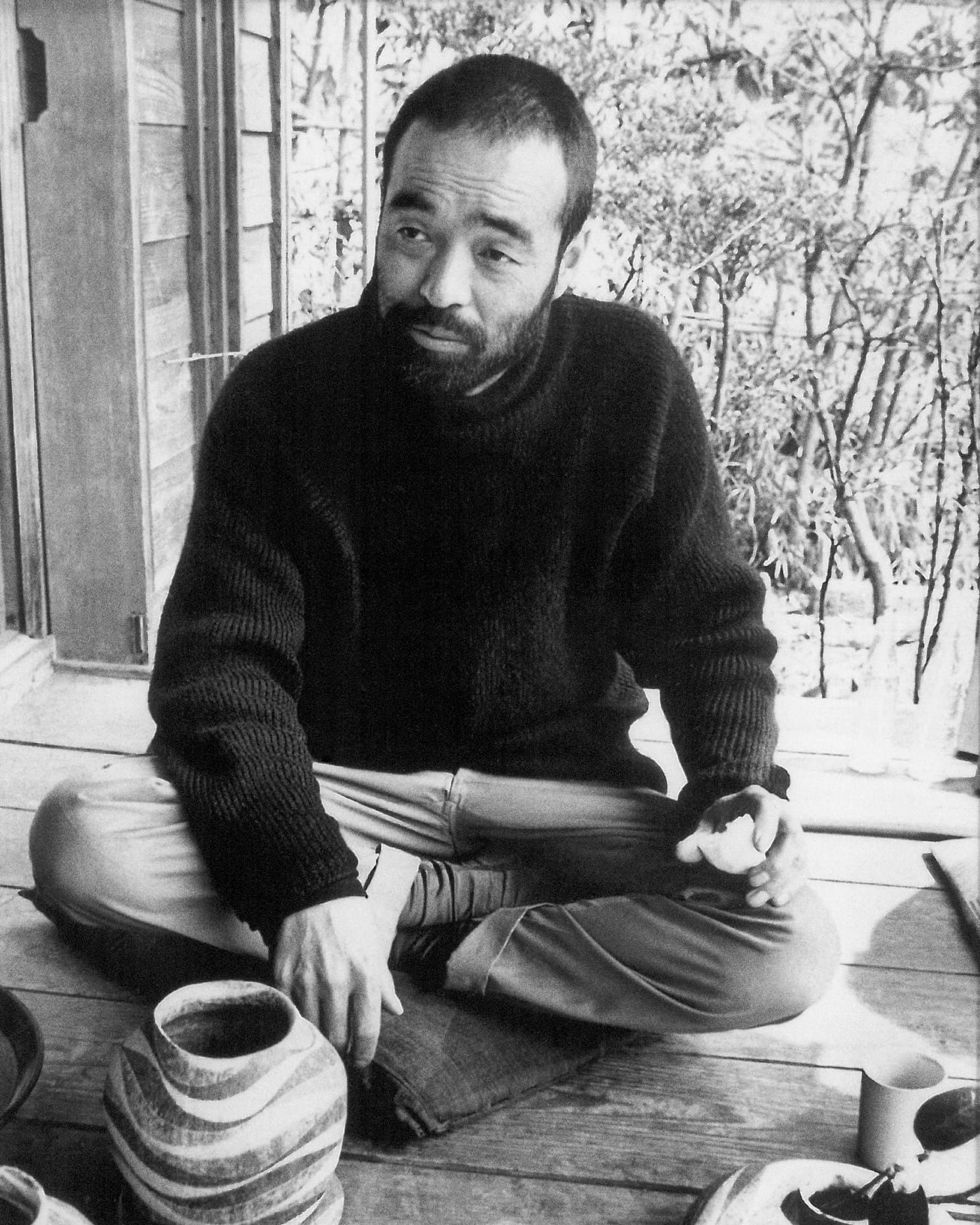
Kamoda Shōji
1933–1983
加守田 章二
Shoji Kamoda was one of the most influential Japanese ceramic artists of the post-war period. His innovative approach to form and surface, particularly during a prolific period between 1967 and 1978, reshaped the direction of modern Japanese ceramics. Born in Osaka, he trained at the Kyoto Municipal Institute of Industrial Research before establishing an independent studio practice.
In 1967 Kamoda was awarded the Takamura Kōtarō Prize, the first time the award had been given to a potter, marking the beginning of his rise to prominence. By 1969, after relocating to Tōno City in Iwate Prefecture, he entered the most significant period of his career.
Kamoda developed a highly individual style combining elegant vessel forms with stylised motifs applied through carving, slip and glaze. His work explores the relationship between structure and surface pattern, producing compositions that feel both precise and lyrical.
During his career his work was widely exhibited in Japan and received recognition at major exhibitions including Nitten and the Japan Traditional Crafts Exhibition. Although his career was cut short by his death in 1983 at the age of 49, Kamoda’s influence has continued to grow. Today his work is widely regarded as one of the most important bodies of work in modern Japanese ceramics.